

🔥 Fish Finder Black Friday Deals for 2026: picks worth watching →
You are standing on the shore of a quiet lake, casting your line into the water, but you have no idea what lies beneath. Are fish hiding near that submerged log? Is the bottom rocky or sandy? A handheld fish finder eliminates the guesswork, revealing water depth, fish location, and bottom structure in real time. In this guide, we review seven of the best handheld fish finders for 2026, covering wired and wireless models from top brands like Venterior, Yoocylii, and LUCKY. Whether you fish from a kayak, the bank, or through the ice, we have a portable sonar device that fits your style.
If you are new to fish finders, check out our guide on the best fish finders for bass boats for broader context.
Product Comparison


Buying Guide
Wired vs. Wireless Connectivity
The first decision is whether you prefer a wired or wireless fish finder. Wired models, like the Venterior Portable Wired Fish Finder Ice Kayak Fishing Gear, connect the display to a transducer via a cable. They are simple, reliable, and often more affordable. Wireless models, such as the LUCKY Handheld Portable Fish Depth Finders, use a floating sonar sensor that transmits data to the display without cables. This gives you more casting freedom and less clutter on your kayak or boat.
Wireless fish finders are ideal for anglers who move between spots frequently. For a deeper look at wireless options, see our kayak fish finders category page.
Display Quality and Screen Size
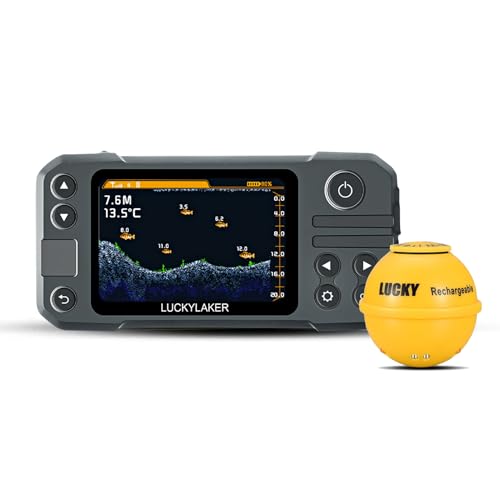
A clear display is critical for reading underwater data quickly. Most handheld fish finders feature LCD screens ranging from 2.2 inches to 3.5 inches diagonally. The LUCKY Kayak Portable Fish Finder Transducer stands out with a 3.5-inch horizontal LCD that scrolls a continuous history of what passes under the sensor. Color displays, like the one on the Venterior Portable Rechargeable Fish Finder, offer better contrast in bright sunlight or at night. Look for adjustable backlighting and selectable background colors for optimal visibility.
Depth Range and Sonar Beam Angle
Depth range determines where you can fish effectively. Most models in our lineup detect water depth from 3 feet down to 328 feet, which covers freshwater lakes, rivers, and coastal areas. The sonar beam angle affects coverage area: a 45-degree beam covers a narrower cone, while a 90-degree or 105-degree beam scans a wider area. For example, the Venterior Portable Rechargeable Fish Finder has a 105-degree beam, making it excellent for scanning large areas from a stationary position.
If you fish in saltwater, ensure the fish finder is rated for marine use. Our best saltwater fish finder guide covers top picks for ocean anglers.
Battery Life and Portability
Battery life matters when you are out on the water for hours. Most wired models run on 4 AAA batteries, lasting 4 to 5 hours of continuous use. Wireless models often have rechargeable batteries in both the display and the sensor. The LUCKY Kayak Portable Fish Finder Transducer offers a massive 853-foot operation distance and a rechargeable sensor that charges via USB. Look for battery save modes to extend run time. Portability is a given with handheld devices, but consider weight and whether they come with a neck strap for hands-free use.
For more tips on choosing portable electronics, read our gifts for kayak lovers article.
Final Thoughts
After evaluating seven handheld fish finders, our top recommendation depends on your fishing style. For anglers who want a simple, wired solution with excellent accuracy at a budget-friendly price, the Portable Wired Fish Finder Ice Kayak Fishing Gear by Venterior is a solid choice. If you prefer a wireless, feature-rich model with a large display and long-range sensor, the LUCKY Kayak Portable Fish Finder Transducer offers exceptional versatility for kayak, shore, and ice fishing. Both models deliver reliable sonar performance to help you find more fish in any freshwater or saltwater environment.
Frequently Asked Questions
How does a handheld fish finder work?
A handheld fish finder uses sonar technology to send sound waves into the water. When these waves hit an object—like a fish, weed, or the bottom—they bounce back to the transducer, which calculates the distance and displays the information on the screen. Most models show water depth, fish depth, fish size, and bottom structure in real time.
Can I use a handheld fish finder for ice fishing?
Yes, many handheld fish finders are designed for ice fishing. Models like the LUCKY Handheld Portable Fish Depth Finders and the Venterior Portable Wired Fish Finder Ice Kayak Fishing Gear work well in ice holes. The sensor is placed in the water through the hole, and the display sits on the ice beside you. Make sure the unit is rated for cold temperatures and that the transducer can be fully submerged.
What is the difference between a castable and a wired fish finder?
A castable fish finder has a wireless sensor that you can cast like a bobber, giving you the freedom to explore different spots without moving your boat or kayak. A wired fish finder has a transducer attached to a cable that you drop into the water; it is typically more stable and offers continuous readings as you move. For a comparison of castable models, visit our castable fish finders category page.
Do I need a fish finder for kayak fishing?
A fish finder can significantly improve your kayak fishing experience by helping you locate fish-holding structure, drop-offs, and thermoclines. Portable handheld models are ideal because they are lightweight, easy to attach to a kayak, and require no permanent installation. For more on kayak-specific setups, see our humminbird vs lowrance comparison for side imaging fish finders.

